Archive

Author Archive

Modeling the Economic Crisis

March 8th, 2010

Joanne Egner Systems Thinking

I’m often asked by customers that are new to Systems Thinking, “How can this approach add value to conceptualizing and understanding common, everyday issues?”  The issues range from business design to environmental concerns to macroeconomic dynamics.  In response to this question, I can tell you from my personal experience, nothing beats seeing a skilled practitioner use our software tools and the Systems Thinking methodology to make sense out of a complex problem.

With this in mind, we collaborated with our consulting and training partner, Lexidyne LLC, to create a new series of video-based presentations focused on common but often misunderstood problems that can be conceptualized, expanded, and then explored using Systems Thinking.  We recently released the first video in this series — Understanding the Economic Crisis presented by Dr. Mark Paich.

Judging from its title, you might think Understanding the Economic Crisis presents a huge complex model of the macro economy.  To the contrary, dynamic modeling expert, Mark Paich, begins with a very simple model of something we all can relate to — the individual consumer.

Stock and flow map of an individual consumer's balance sheet

Mark expands upon the model and shows how a sudden drop in housing prices affects individual consumption.   As you might expect, when Total Net Worth falls, the individual responds by spending less.  When housing prices fall, home equity loans no longer provide the purchasing power for big ticket items like cars, vacation homes and big screen TVs.

The real surprise however, comes when Mark further expands the individual consumer model to include the economy as a whole.  When everyone’s net worth decreases at the same time a phenomena known as the “Paradox of Thrift” occurs. The paradox states that if everyone tries to save money during times of recession, total savings for the overall economy may fall.  The dynamics generated by adding elements of the macro economy to the model are indeed surprising.

Mark’s easily understood model leads to some real insights concerning the policy implications for an economic recovery.   It also provides a great example of how Systems Thinking can be used to deepen your understanding of a complex issue in order to make better decisions.  If you haven’t seen the video, I highly recommend it.  The following trailer highlights some of the key points in Mark’s presentation and will give you a taste of the full presentation.

(If you cannot see the video below in your RSS reader, please visit the post page)

For more information or to purchase Understanding the Economic crisis, click here.

, , , ,

Modeling Real World Challenges Inspires Students

February 4th, 2010

Joanne Egner Education

Last summer I had the opportunity to see students from Diana Fisher’s dynamic modeling class at Wilson High School in Portland, Oregon present their modeling projects to participants of the International System Dynamics Society Conference in Albuquerque. The parallel session was filled with educators and professionals from different fields, many of whom are renowned system dynamicists.

I think it is safe to say that we all were very impressed by the quality of the students’ work and how well they understood the dynamics associated with the issues they were presenting.  Perhaps more striking however, was seeing how empowering modeling real-world issues is for young people and the enthusiasm they share for their work.

CC Modeling SystemsNow everyone can see the effect that modeling real-world issues has on students at the CC Modeling Systems web site. Dedicated to helping educators bring dynamic modeling into the classroom, the web site features videos of students presenting their work as compelling evidence to the value of incorporating System Thinking and system dynamics into curriculum.

You’ll be amazed to see what 14-18 year olds are capable of and the excitement they exuberate when addressing challenges such as:

Students are eager to understand the world better and are more than capable of building and understanding relatively sophisticated models in their attempts to understand the dynamics of real-world systems.

—Diana Fisher

Educators and administrators considering dynamic modeling curricula typically face challenges. No matter how compelling the evidence that Systems Thinking and the system dynamics methodology engages students and takes them to a higher level of reasoning, it is still difficult to justify without tying it to National Standards.

The CC Modeling Systems web site devotes an entire section to detailing very specific 21st Century Skills and National Standards addressed by curriculum that incorporates building system dynamics models.   Much of the homework has been done aligning this type of work to standards in the following subject areas:

Many thanks to Diana Fisher for sharing her students and her experiences teaching dynamic modeling with all of us!

To learn more about the modeling course that Diana teaches, I recommend the following links:
Recorded webinar presentation by Diana Fisher
Modeling Dyamic Systems: Lessons for a First Course

, ,

Humanities Major Attempts Dynamic Modeling and Survives!

January 15th, 2010

Joanne Egner Training

This post is written by Rolf Olsen, a participant in our Introduction to Dynamic Modeling with iThink and STELLA workshop held last month in Colorado Springs.  We thought Rolf’s perspective would offer insights for those of you who are new to Systems Thinking or curious about applying dynamic modeling to real-world issues.

Rolf Olsen, Workshop Participant

I was very excited about a last-minute chance to attend the introductory iThink/STELLA workshop, but to be honest, on the flight to Colorado Springs, I started to become apprehensive.  Who was I trying to kid?  Sure, I’d heard the terms “stock” and “flow” and I understood their roles as the nouns and verbs of the software.  I’d even read a few chapters in Barry Richmond’s Introduction to Systems Thinking.  But the first time I started up the software and stared at that blank workspace, I had no clue where to begin!  Adding to my anguish, I was quite certain there would be others there who were much smarter than me and really knew what they were doing.

In college I spent most of my time and energy studying English and French, language, literature, cinema, art history, and so forth. I managed to avoid all higher math like the plague (although I did reasonably well in basic statistics).  My engineer father often reminded me that my degree in Humanities prepared me for almost nothing.  After college, I stumbled into a career in marketing – quite fertile territory for exploring system dynamics and modeling, as it turns out.  I spent a few formative years in an ad agency and at a regional banking system, before finding my stride marketing and managing nonprofit arts and culture organizations. Today I work in marketing and communication in a large academic medical center.

For years I’ve used spreadsheets to model various ‘what if’ scenarios.  In the arts, I used spreadsheets to create budgets and set ticket prices, always seeking ways to better predict revenue from ticket sales at different prices, for different types of performances (e.g., modern dance, string quartet, jazz ensemble), or on different days of the week.

Preparing for the iThink/STELLA workshop, I decided I’d like to try to model demand in a market area for laser vision correction surgery, popularly known as LASIK or PRK.  That seemed simple enough.  I might be able to bluff my way through this workshop after all!

Read more…

Top Blog Posts of 2009

December 18th, 2009

Joanne Egner News & Announcements

isee_blog_icon_128In 2009, the isee systems blog, “Making Connections” was created as a forum for sharing ideas and experiences with the Systems Thinking community. Blog topics cover subjects ranging from a systems perspective of current news events to modeling tips for advanced STELLA and iThink users.

As the first anniversary of the isee Blog approaches, we thought it would be interesting for folks to see the list of our most popular blog posts.


Top Ten Posts of 2009

  1. Modeling H1N1 Flu Outbreak
  2. Modeling Customers Switching Between Brands
  3. Modeling a Watershed with Arrays
  4. Matrix Arithmetic
  5. Spatial Modeling with isee Spatial Map
  6. “Thinking in Systems” book inspires online course
  7. Physics Textbook 2.0
  8. Insight-based Model Investigates the Housing Crisis
  9. Building a Health Care Model Hierarchically
  10. C02 in the Atmosphere Behaves Like a Bathtub

Incorporating STELLA into STEM Education

November 18th, 2009

Joanne Egner Education

MODSIM 2009Jeremy and I recently attended the MODSIM 2009 Conference in Virginia Beach where we facilitated a pre-conference workshop with the help of Mark Clemente, a local high school science teacher.

We’ve been working with Mark over the past year to incorporate dynamic modeling and computer-based simulation into the STEM curriculum at Ocean Lakes High School in Virginia Beach.  Ocean Lakes is serving as a demonstration school for a broader initiative in Virginia to use Modeling and Simulation (MODSIM) as an engine for 21st Century workforce development.

One of our goals for the pre-conference workshop was to provide participants with STELLA models and lessons that they could use immediately in their classrooms.  To attain this we put together a packet of sample lessons that would cover the spectrum of STEM education courses—Science, Technology, Engineering and Mathematics.

Science: Exploring an H1N1 flu outbreak model

Educators at all levels have found that physical activities or games can often be a good way to introduce students to STELLA models. Activities can be a lot of fun and provide a physical model for kids to make the connection with the more abstract computer-based simulation.

In our workshop, we decided to introduce a STELLA model of the H1N1 flu outbreak by first engaging the class in a simple exercise that demonstrates the spread of infectious disease using cups of water.  Each student was given a cup of water and a pipette.  One cup of water however, was contaminated with sodium hydroxide.   We then began the process of walking around and dropping a pipette filled with liquid from our own cup into the cups of fellow students.  At the end of several rounds, Mark (our teacher) put a drop of phenolphthalein solution into everyone’s cup.  If the liquid turned pink, we were infected.

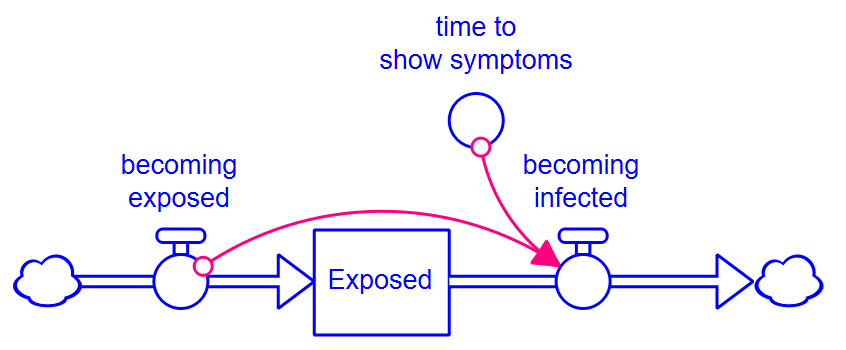
With a new understanding of how quickly infection can spread, the class was ready to be introduced to a STELLA model of the H1N1 flu outbreak.  The core structure of the model is based on the same model that epidemiologists use to track a population through the various stages of infection including Susceptible, Exposed, Infected and Recovered (SEIR).

The simulation provided several controls for students to experiment with different policy options for controlling the spread of the virus.   Along with the model, we provided a sample lesson with a set of questions to help guide students through their exploration.  To download the H1N1 model and sample lesson, click here.

Technology: Inquiry-based learning with STELLA simulations

It was fascinating to watch how each student in our workshop experimented differently with the model and began asking their own set of questions.  STELLA simulations and computer technology provide the perfect platform for students to learn using an inquiry-based approach.  Rather than being told how something works, students can discover for themselves by exploring “what-if” scenarios and finding out what happens. For teachers, this can mean shifting from a traditional teacher role to that of a facilitator or coach, guiding students in their inquiry without knowing in advance the path they’ll choose.

Engineering/Physics: The Pendulum Story

pendulumAnother STELLA model that we introduced to workshop participants was one that Mark and I modified for the Physics Flexbook project earlier this year.  The original version was developed by Diana Fisher in her book Lessons in Mathematics: A Dynamic Approach. The model provides a practice field for learning how the variables of simple harmonic motion are related.  Controls in the simulation allow you to explore what effect, if any, string length, initial displacement, and pendulum ball mass have on the amplitude, period, and frequency of the pendulum’s motion.  To download the pendulum model and sample lesson, click here.

Mathematics: Algebra Word Problems

You may remember from your own experience in math class that word problems typically give students a lot of trouble!  It is especially difficult to understand what is important in the problem and how to translate words into mathematical equations.  STELLA can help by allowing students to create a visual representation of the problem and making it easier to understand the symbolic representation.

For the workshop, we used the following word problem as an example of a typical Algebra I assignment:

Imagine your class is going to try to raise $400 by making school T-shirts. There is a $150 set-up charge for the T-shirt design that you have designed. Once the design is set, it costs $4 for each T-shirt. You feel it is possible to charge $10 for each T-shirt. How many T-shirts do you have to sell before you break even, i.e., make enough money to cover your costs?

Together we created a STELLA model that provided a visual representation of the word problem and gave everyone some hands-on experience building models from scratch.  It also inspired some participants to think about ways they could expand or change the model to answer additional questions that weren’t part of their immediate assignment. 

Tshirt

To download the T-shirt model and lesson, click here.

We’d love to expand our library of STELLA lessons and models so that we can share them with teachers.  If you’ve got any ideas of things you’d like to try in your classroom, please feel free to contact us – we’re here to help!

, , , , , , , , ,

2009 Barry Richmond Scholarship Award

August 5th, 2009

Joanne Egner News & Announcements

Marcus Robinson and James Ranney accept 2009 Barry Richmond Scholarship Award

Marcus Robinson & James Ranney accept 2009 Barry Richmond Scholarship Award

The Barry Richmond Scholarship Award was established in 2007 by isee systems to honor and continue the legacy of our founder, Barry Richmond.  Barry was devoted to helping others become better “Systems Citizens”.  It was his mission to make Systems Thinking and System Dynamics accessible to people of all ages and in all fields.

The award is presented annually at the International System Dynamics Conference to an individual whose work demonstrates a desire to expand the field or to apply it to current social issues.

Barry had a particular passion for expanding the field into K-12 education.  He worked closely with teachers and young people at all levels to incorporate Systems Thinking tools and methodologies into the classroom.  With this in mind, it was a great pleasure to present this year’s award to Marcus Robinson and James Ranney, two students from Wilson High School in Portland, Oregon.

Marcus Robinson presents at SD Conference

Marcus Robinson presents at SD Conference

The scholarship committee was very impressed by the quality of the models and technical papers that these students submitted.   Both high school seniors were enrolled in Diana Fisher’s modeling class this past year.  For their final project assignment, they were asked to explore a topic of their own choosing.

Inspired by a video of the PBS NOVA program “Dimming the Sun”, Marcus chose to create a model that would help to answer the question “How Much do Carbon Emissions Need to be Reduced in Order to Stop Global Warming?” To download Marcus’ paper, click here.

After a run-in with a large frog at his summer camp, James was interested in answering “What is the Impact of Introducing an Invasive Species into an Ecosystem?” – in this case, the bullfrog into the Pacific Northwest. To download James’ paper, click here.

James Ranney presents during K-12 poster session

James Ranney presents during K-12 poster session

Both students presented their work at a parallel session during the conference and again at a special K-12 poster session.  What a delight it was to see how empowering modeling real-world issues is for young people and the enthusiasm they share for their work.

Thank you to the society for making a special effort to serve the K-12 community and provide opportunities for partnership.  Congratulations Marcus and James, Barry would be very proud!

Applications for the 2010 Barry Richmond Scholarship Award will be available on the isee systems and System Dynamics Society web sites. Check those sites for more information.


, , ,

System Dynamics Conference in Albuquerque

July 21st, 2009

Joanne Egner News & Announcements

System Dynamics Society We’re looking forward to connecting with folks at the 27th Annual International System Dynamics Conference in Albuquerque next week.   Karim Chichakly, Jeremy Merritt and I will be there to share the latest news, listen to your stories, and answer any questions you might have.

We hope to see you at as many of the following isee sponsored events as your schedule allows:

Monday, July 27th

8:00 – 6:00 PM isee systems Exhibit Booth Open
12:30 – 1:00 PM isee systems Exhibitor Demonstration
1:00 – 1:50 PM STELLA and iThink User Group Meeting

Tuesday, July 28th

8:00 – 6:00 PM isee systems Exhibit Booth Open
7:00 PM Barry Richmond Scholarship Award Presentation

Wednesday, July 29th

8:00 – 6:00 PM isee systems Exhibit Booth Open

Thursday, July 30th

8:30 – 10:00 AM Getting Started with STELLA and iThink Workshop (Part 1)
Modeling Dynamic Systems: Lessons for a First Course
Workshop by Diana Fisher
10:30 – 12:00 PM Getting Started with STELLA and iThink Workshop (Part 2)
1:00 – 2:30 PM Creating Simulations for the Web with iThink & STELLA Workshop

See you in Albuquerque!

,

Success to the Successful

July 15th, 2009

Joanne Egner STELLA & iThink

fifth_disciplineMy first introduction to the Systems Archetypes was years ago when I read Peter Senge’s book, The Fifth Discipline.  I remember relating these classic Systems Thinking stories to my own experience in business and thinking how useful it was to understand some of the problems we faced and why solutions didn’t always work out as intended.

What I’ve come to appreciate since then is how the characteristic themes of the Systems Archetypes transform across all sorts of different fields and situations — even our personal lives!

Take, for example, the basic story line of the “Success to the Successful” archetype:

When given the choice, we invest our resources where we expect them to deliver the best results.  By giving more resources to one option over another, we create a self-fulfilling prophesy whereby the favored option is perpetually more successful.

The story of the Success to the Successful archetype applies to all sorts of  situations leading to well-known patterns of behavior:

Exploring the Model Structure

We recently published a model of the Success to the Successful archetype to the web using isee NetSim. Exploring the model is a great way to understand the underlying structure of the Causal Loop Diagramsystem and think about ways to avoid the problems it creates.

You’ll also get an appreciation of how the decision policy for allocating resources can determine success rather than competence.

Running the Simulation

After you’ve explored the model, try running a simulation.  The base case scenario assumes no one has an advantage over the other.  As you can imagine, everyone is equally successful and it’s a win-win situation.  Try turning on the “Advantage A Switch”  to see how even a modest advantage for A can snowball into a disadvantage for B.  It’s surprising how quickly the gap can widen.

Using Modules to Create Models

In STELLA and iThink version 9.1, we added the ability to build models by linking together modules.  The Success to the Successful model is an example of how you can use modules to create a higher level map of your model.  This map can easily be presented as a causal loop diagram.

The beauty of modules is they simplify the process of transitioning from a CLD to a model that actually simulates.  If you’ve ever tried to convert a causal loop diagram into a stock and flow model, you can appreciate what I’m talking about!  By architecting your model into modules, you’ve got a built-in mechanism for developing your model in manageable chunks and communicating the high level causal relationships.

, , ,