Archive

Posts Tagged ‘iThink/STELLA’

Modeling Bass Diffusion with Rivalry

February 18th, 2010

Karim Chichakly STELLA & iThink

This is the last of a three-part series on the Limits to Growth Archetype.  The first part can be accessed here and the second part here.

Last time, we explored the effects of Type 1 rivalry (rivalry between different companies in a developing market) on the Bass diffusion model by replicating the model structure.  This part will generalize this structure and add Type 2 rivalry (customers switching between brands).

Bass Diffusion with Type 1 Rivalry

To model the general case of an emerging market with multiple competitors, we can return to the original single company case and use arrays to add additional companies.  In this case, everything except Potential Customers needs to be arrayed, as shown below (and available by clicking here).

image

For this example, three companies will be competing for the pool of Potential Customers.  Each array has one-dimension, named Company, and that dimension has three elements, named A, B, and C, one for each company.  Although each different parameter, wom multiplier, fraction gained per $K, and marketing spend in $K, can be separately specified for each company, all three companies use the same values initially.  All three companies, however, do not enter the market at the same time.  Company A enters the market at the start of the simulation, company B enters six months later, and company C enters six months after that.

Recall that the marketing spend is the trigger for a company to start gaining customers.  Thus, the staggered market entrance can be modeled with the following equation for marketing spend in $K:

STEP(10, STARTTIME + (ARRAYIDX() – 1)*6)

The STEP function is used to start the marketing spend for each company at the desired time.  The ARRAYIDX function returns the integer index of the array element, so it will be 1 for company A, 2 for company B, and 3 for company C.  Thus, the offsets from the start of the simulation for the launch of each company’s marketing campaign are 0, 6, and 12, respectively.

This leads to the following behavior:

image

Note that under these circumstances, the first company to enter the market retains a leadership position.  However, companies B and C could anticipate this and market more strongly.  What if company B spent 50% more and company C spent 100% more than company A on marketing that is similarly effective?  This could be modeling by once again changing the equation for marketing spend in $K, this time to:

STEP(10 + (ARRAYIDX() – 1)*5, STARTTIME + (ARRAYIDX() – 1)*6)

Read more…

, , , ,

Developing a Market Using the Bass Diffusion Model

January 21st, 2010

Karim Chichakly STELLA & iThink

This is part two of a three part series on Limits to Growth.  Part one can be accessed here and part three can be accessed here.

In part one of this series, I explained the Limits to Growth archetype and gave examples in epidemiology and ecology. This part introduces the Bass diffusion model, an effective way to implement the capture of customers in a developing market. This is also used to implement what Kim Warren calls Type 1 rivalry in his book Strategy Management Dynamics, that is, rivalry between multiple companies in an emerging market.

The Bass Diffusion Model

The Bass diffusion model is very similar to the SIR model shown in part one. Since we do not usually track customers who have “recovered” from using our product, the model only has two stocks, corresponding loosely to the Susceptible and Infected stocks. New customers are acquired through contact with existing customers, just as an infection spreads, but in this context this is called word of mouth (wom). This is, however, not sufficient to spread the news of a good product, so the Bass diffusion model also includes a constant rate of customer acquisition through advertising. This is shown below (and can be downloaded by clicking here).

image

The feedback loops B1 and R are the same as the balancing and reinforcing loops between Susceptible and Infected in the SIR model. Instead of an infection rate, there is a wom multiplier which is the product of the Bass diffusion model’s contact rate and the adoption rate. If you are examining policies related to these variables, it would be important to separate them out in the model.

The additional feedback loop, B2, starts the ball rolling and helps a steady stream of customers come in the door. If you examine the SIR model closely, you will see that the initial value of Infected is one. If no one is infected, the disease cannot spread. Likewise, if no one is a customer, there is no one to tell others how great the product is so they want to become customers also. By advertising, awareness of the product is created in the market and some people will become customers without having encountered other customers who are happy with the product.

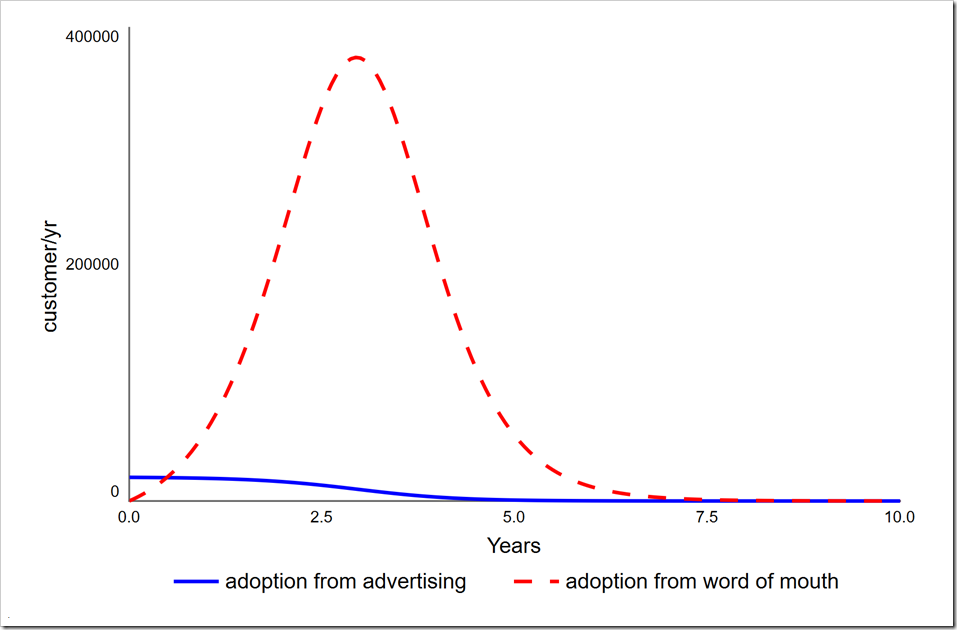
The behavior of this model is shown below. Note it is not different in character from the SIR model or the simple population model.

image Read more…

, , ,

Modeling Customers Switching Between Brands – The General Case

October 23rd, 2009

Karim Chichakly Modeling Tips

This is the last installment of a four-part series.  The first three parts can be accessed by clicking on the links below.
Methods for Using Arrays Effectively

Modeling a Watershed with Arrays
Modeling Customers Switching Between Brands

Generalizing the Model

When I showed Steve Peterson (at Lexidyne) my brand switching model, he told me there is a more general version that separates the customer loss fraction from the fraction won by another competitor.  This has been presented in Pharmaceutical Product Strategy by Mark Paich, Corey Peck, and Jason Valant.

In my original formulation, the switching probability matrix was the product of these two variables.  However, in many practical cases, the data available comes from two different places and reflects these two separate components.  The revised model structure is shown below.

image

Instead of one composite switching probability, this model uses a switching out probability that is distinct from the switching in probability.  The switching out probability is a one-dimensional array that, for each product, contains the fraction of customers lost to rivals every time unit (in our case, month).  A sample for the five brands A, B, C, D, and E appears below.

Brand Fraction Lost
A 0.091
B 0.170
C 0.046
D 0.026
E 0.071

switching out probability

We can see from this table that Brand B is losing 17% of its customers to rivals each and every month!  Whoever is managing that product had better do something quickly.

The other side of the story has to do with which brand the customers are switching to.  The switching in probability matrix contains, for each brand, the fraction of lost customers that migrate to a rival brand.  Thus, each row of this matrix must add up to one (100% of lost customers).  A sample appears below.

From\To A B C D E
A 0.00 0.11 0.33 0.55 0.01
B 0.18 0.00 0.29 0.41 0.12
C 0.22 0.02 0.00 0.44 0.32
D 0.04 0.00 0.77 0.00 0.19
E 0.02 0.07 0.28 0.63 0.00

switching in probability

Note the diagonal will always be zero.

We can determine a lot of things from this table.  For example, brand B offers no competition to brand D, brand D is the biggest rival of all the other brands, and brand C is brand D’s biggest rival.

Read more…

, , ,

Running Mean and Standard Deviation

October 22nd, 2009

Karim Chichakly Modeling Tips

This is an update to post published on August 31, 2009.  The attached model was updated to find negative means and an alternate method was included at the end.

I am frequently asked which built-in function gives either the running mean or running standard deviation of a model variable.  Unfortunately, there is no such built-in at this time (no, that is not what MEAN() does).

Luckily, however, we can replicate the behavior we desire from built-in functions by creating a reusable module.  I can create a module that calculates a running average and a running standard deviation from any model variable.

When building a reusable module component, it is important to carefully define what the input to the module will be (i.e., what are the parameters to the built-in function) and what the output of the module will be (i.e., what is the result or return value of the built-in function).  In this particular case, the input will be the variable whose running average or running standard deviation we wish to find.  There are two outputs:  the running average and the running standard deviation.  Note we do not have to use both outputs all the time.

Thus, our new module can be used as shown below:

image

Note the name of the module was chosen to give a meaningful context to the running mean and standard deviation variables, which have fixed names defined inside the reusable module.  As in this example, it is always a good idea to give the module outputs general names that make sense when qualified by a context (the module name).

The reusable module itself was built and tested in iThink, and can also be used in STELLA.  The input parameter was given an equation to allow the model to be completely tested and debugged before being reused.  The model appears below and can be downloaded by clicking here.

image

Note the input to the module is named value.  After importing the module, this will need to be assigned to the variable in question, Cash in the above example.  This can be done from outside the module by right-clicking on Cash and choosing “Module->Assign to”, or right-clicking on value and choosing “Module->Assign Input to”.  The outputs can be assigned in a similar way, or the Ghost tool can be used.

This method, while relatively easy to understand, does accurately compute the standard deviation when the mean of the running sum of squares is close in magnitude to the running mean squared.  An alternate method that does not suffer this problem was developed by Welford in 1962 and is implemented in the model that can be downloaded by clicking here.

Finally, I am including a simple reusable module that finds the maximum value of a model variable across the entire run of a simulation.  It can be downloaded by clicking here.  It uses a stock to hold the maximum value seen so far, and takes advantage of the fact that uniflows cannot be negative.  It is used the same way as the running mean and standard deviation module, but only has one output called maximum.

For more information about modules, consult the iThink and STELLA help files.  These on-line resources are also available:

Using Modules Webinar

Module FAQs

, , ,

Modeling Customers Switching Between Brands

September 30th, 2009

Karim Chichakly Modeling Tips

This is the third installment of a four-part series.  The other three parts can be accessed by clicking on the links below.
Methods for Using Arrays Effectively

Modeling a Watershed with Arrays
Modeling Customers Switching Between Brands – The General Case

In the second post of this series, I showed how to selectively pull information from an array in order to route water through a watershed.  In this post, I will use the exact same technique to move customers between different product brands.

Switching Customers between Different Products

Business models often need to model gaining customers from, and losing customers to, competing products in a relatively mature market (what Kim Warren, in his excellent book Strategy Management Dynamics, calls “Type 2 Rivalry”).  These are often driven with statistical models developed through market research.  For this application, we need a matrix describing the probability of switching from product A to product B each time unit.  A sample appears in the table below.

From\To A B C D E
A 0.000 0.010 0.030 0.050 0.001
B 0.030 0.000 0.050 0.070 0.020
C 0.010 0.001 0.000 0.020 0.015
D 0.001 0.000 0.020 0.000 0.005
E 0.001 0.005 0.020 0.045 0.000

switching probability (units: dimensionless)

To read this table, locate the product the customer is presently using in the left column (say, B).  Read across that row (the second row, in this case) until you find the product the customer is switching to (say, C).  The number in that cell (in this case, 0.05 or 5%) is the probability the customer will switch from the first product to the second (from B to C) in this time unit.  If the model is running in months, as ours is, this table indicates that 5% of customers using product B switch to product C every month.

Of course, the values in the table do not need to be constant.  Often each cell will contain a regression equation based on various product characteristics – including market share, marketing effort, product features, and product quality – that evolve over the course of the simulation.

Note the diagonal is zero.  This means customers do not switch from one product to the same product.

Note also that the sum in any row cannot exceed 1.0, which represents 100% of the customers using that product.  It is quite normal for it to be below 1.0 because we do not include people who are not switching.  Some modelers find it easier to always have each row add up to 1.0.  If you desire to do this, fill the diagonal with the difference between 1.0 and the sum of the other columns.  For example, to do this for product A, replace the top left cell with 1.0 – (0.01 + 0.03 + 0.05 + 0.001) = 0.909 [for you Beatles fans].

Read more…

, , ,

Modeling a Watershed with Arrays

September 15th, 2009

Karim Chichakly Modeling Tips

This is the second installment of a four-part series.  The other three parts can be accessed by clicking on the links below.
Methods for Using Arrays Effectively

Modeling Customers Switching Between Brands
Modeling Customers Switching Between Brands – The General Case

This is the second installment of a multipart series.  The first part can be found by clicking here. Part 3 is available here.

In the first post of this series, I showed how to conditionally pull information from an array.  In this post, I will extend this concept to show how to route information through an arrayed model.  This is especially useful in spatial modeling applications.

Routing Water Through a Watershed

A common ecology application is the modeling of a watershed.  Part of such a model will necessarily involve a network of stream or river segments – called reaches – which feed each other.  It is desirable to implement this in a way that makes it easy to modify the reach network.  Using an explicit stock-flow network makes this very difficult.  However, it is relatively straightforward to use arrays of stocks and flows to build an easily configurable network.

Imagine a small watershed broken down into reaches as shown below:

clip_image001[6]

For our purposes, a new reach will need to be created at every junction point.  Therefore, in this example and from a topological point-of-view, it is not strictly necessary to treat reach 4 separately from reach 2 nor reach 5 separately from reach 3, but reaches 2 and 3 must be separate from reach 1.  There are, of course, other reasons to separate reach 4 from 2 and reach 5 from 3, for example, slope, channel width, length, etc.

Every reach flows into exactly one other reach at its head, but many reaches can flow into the head of the same reach.  This requires a many-to-one representation of the reach network.  This is accomplished quite easily with a routing map which, for each reach, contains the number of the reach that this reach flows into.  We also need someway to signify the outlet.  Since reach numbers start at one, we can use zero to signify the outlet.  Using these rules, the above network is completely represented in the following routing map:

Reach Flows into
1 0
2 1
3 1
4 2
5 3

The nice thing about this representation is that it fits nicely into a one-dimensional array where the array index is the reach number and the reach it flows into is the value stored in that array element.

The model itself uses one stock to represent each reach.   That stock has one inflow for water entering the reach and one outflow for water leaving the reach: (Download the zipped STELLA model here)

image

Read more…

, , ,

Methods for Using Arrays Effectively, Part 1

September 7th, 2009

Karim Chichakly Modeling Tips

This is the first installment of a four-part series.  The remaining three parts can be accessed by clicking on the links below.
Modeling a Watershed with Arrays
Modeling Customers Switching Between Brands
Modeling Customers Switching Between Brands – The General Case

Using arrays can be quite intimidating for most people. Many times, it is difficult to discover the correct way to formulate a problem in terms of arrays, especially when trying to do so in terms of single equations that can be applied to all elements of the array.

Consider the case where you might wish to count the number of occurrences of a value in an array. This can arise in many applications that need to track attributes, but is prevalent in spatially-explicit business applications. In such an application, you may associate a product code with a location and then want a count of the products of a given type. The following examples demonstrate a common way to extract conditional information from an array.

Finding the Number of Stations with a Given Status

Imagine you have a two-dimensional grid of fire stations in a city, called Stations, that stores one of four statuses:

0: no station in this sector
1: ready
2: away on a call
3: refitting

You consider the number of fire stations ready at any given moment to be an important metric. To calculate this, connect Stations to another two-dimensional array of the same size called ready stations. This will have a one in an array element if the station for that quadrant is ready and a zero otherwise.  Its equation is:

IF Stations[Y, X] = 1 THEN 1 ELSE 0  { station ready? }

Note this equations uses dimension names (i.e., Stations[Y, X]) rather than element names (e.g., Stations[1, 2]). This allows you to create just one equation for the entire array (with “Apply to All” turned on), rather than a separate equation for each individual array element (with “Apply to All” turned off). When “Apply to All” is turned on, the equation for each element of the array is automatically generated by substituting that element’s dimensions for the dimension name in the given equation. All of the examples in this post use dimension names.

The total number of ready stations is now just the sum of all of the elements in the array ready stations.  This is easily calculated by connecting ready stations to a scalar converter named total ready stations that has the equation

ARRAYSUM(ready_stations[*, *])

The model is shown below and can be downloaded by clicking here.

image

This general method can be used anytime we need to count the number of elements in an array based on some condition.  First, create an array that has its elements set to one if the array-based condition is met and zero otherwise (IF condition THEN 1 ELSE 0).  Then create a converter to sum the elements of this new array (using ARRAYSUM).  Remember to turn “Apply to All” on and use dimension names in the condition rather than element names.

Read more…

, ,

Matrix Arithmetic

July 14th, 2009

Karim Chichakly Modeling Tips

iThink and STELLA support a variety of matrix operations. In this post, I will explain the following common operations and how to perform them:Matrix Cube

In the examples provided, I use five different arrays of varying dimensions. They are all defined using the subscript name Dim3, which is size 3.

a: 3×3
b: 3×3
c: 3×3
d: 3×1 [one-dimensional]
e: 3×1 [one-dimensional]

I also use two arrays based on Dim3, as well as the subscript name Dim2, which is size 2.

s: 2×3
t: 3×2

Read more…

, ,