Skip to content

Making Connections

isee systems blog

Making Connections

  • About
  • More Connections
Search

“Thinking in Systems” book inspires online course

Updated: June 17, 2009March 6, 2009Filed under: Training13 Comments

One of the questions I often get asked in both my professional and personal life is “What is Systems Thinking?”  It seems like a simple question but the answer can be very different depending on who you’re talking to.  Much of my career has been involved in the development of software so it is only …
Keep Reading
Training
  • books
  • Donnella Meadows
  • online course
  • Systems Thinking
  • Thinking in Systems
  • webinar
13 Comments

LOOKUPXY Built-in Increases Dataset Flexibility

Updated: March 25, 2009March 3, 2009Filed under: Modeling Tips66 Comments

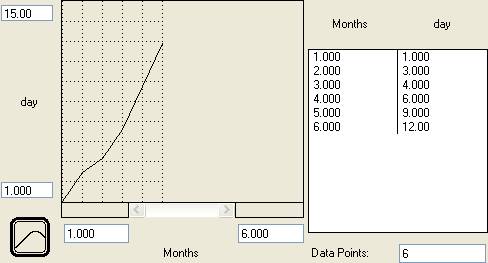
Version 9.1.2 adds the ability to incorporate non-regularly sampled data easily into your models.  Many people use the graphical function for historical records of data.  The graphical function, however, assumes a fixed interval along the x-axis.  This can make it difficult to use data like the following:

Day Flow
1 12.1
3 7.6
4 15.2
6 13.5
9 23.8
12 17.3

While it is easy to determine the fixed interval to use to capture all of these points (1 day), it is more difficult to determine what data points to use for the missing intermediate 1-day values.  There are also many cases where it is very difficult to find a fixed interval that works for a given dataset.

Graphical Function Day
Graphical Function Day (click for full size)

The LOOKUPXY built-in was specifically added to address this issue.  It is unique in that it requires two separate graphical functions:  one for the x-coordinates of each pair and one for the y-coordinates of each pair.  The number of points in each graphical function should match; if they do not, extraneous points are ignored.  The data values (x-coordinates and y-coordinates) are both entered by the user as the y-values in each graphical function.  The x-values in each graphical function are ignored; only the number of points matter.  It is a good idea, though, to run the x-axis of both from one to the number of points.  That way, it is easy to verify that the values in each graphical function properly align with one another.  In addition, the x-coordinates should be in increasing order.  If they are not, however, the program will automatically readjust them when the model is first run.

(more…)

Modeling Tips
  • builtins
  • graphical function
  • iThink/STELLA
  • lookupxy
  • Version 9.1.2
66 Comments

Physics Textbook 2.0

Updated: March 25, 2009February 27, 2009Filed under: Education1 Comment
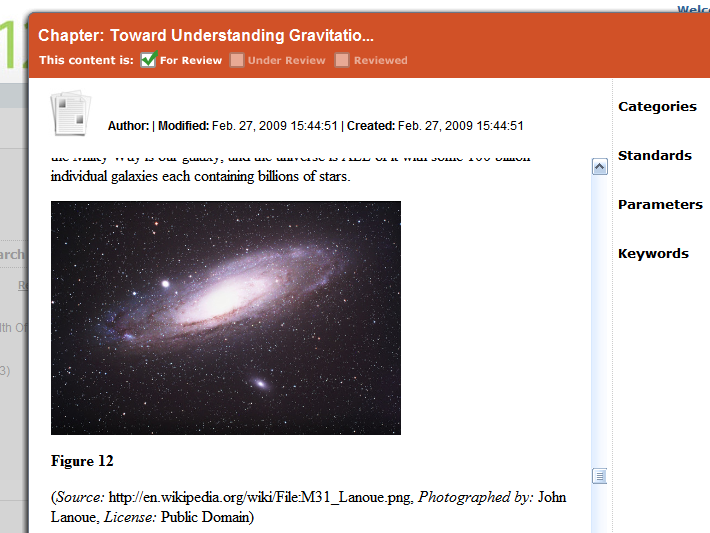
Online Physics Flexbook
Online Physics Flexbook (click to expand)

Imagine a textbook that you can download, is open-source, is up to date with the latest information and you can comment on? Well, it exists. It’s called a “Flexbook” and today the state of Virginia released a Physics Flexbook online for a 2 week public review.

The 11 chapter online textbook contains a chapter devoted to teaching physics with modeling and simulation. It uses three Learning Labs developed with STELLA and allows students to interact with them using the free isee Player.

We got involved with the Physics Flexbook project last fall when we met the director of the program, Jim Batterson, at the MODSIM Conference in Virginia. He told us about a “wiki-style” online physics textbook that allowed teachers and scientists to collaboratively develop the content. The content would be free for anyone to use, share and adapt and contain the latest scientific information.

We thought this sounded like a fantastic idea and pledged our support for a chapter of the book that incorporates modeling and simulation to teach physics. Our friend Mark Clemente wrote the chapter and we setup a web page to host the STELLA models and allow easy access to the isee Player to interact with the models.

Earlier this week, Joanne and I were back in Virginia for the VSTE 2009 Conference (Virginia Society for Technology in Education). We attended Jim Batterson’s session on the Physics Flexbook where we got the full story on the inception and development of Virginia’s first open-source, online textbook. The session was very inspiring.

Jim Batterson is a retired NASA Engineer, former physics teacher and school board member. While Jim was at NASA he was chosen to direct a review of Virginia’s Standards of Learning (SOL) in science education. The goal was to come up with recommendations for the state on how to better meet the needs of the 21st century workforce.

(more…)

Education
  • Creative Commons
  • MODSIM
  • Open Source
  • Physics
1 Comment

Posts pagination

  • Previous
  • 1
  • …
  • 22
  • 23
  • 24
  • 25
  • 26
  • 27
  • 28
  • 29
  • Next

Categories

  • Education (4)
  • isee NetSim (3)
  • isee.NET Framework (1)
  • Modeling Tips (32)
  • News & Announcements (17)
  • STELLA & iThink (15)
  • Stories from the Field (5)
  • Systems Thinking (8)
  • Training (6)

Archives

Browse by keyword

2D array archetypes arrays Barry Richmond Bass diffusion builtins calibration Causal Loop CLD command line conferences crisis data diffusion Education environment export game graphical function h1n1 healthcare housing import iThink/STELLA market dynamics MODSIM modules mortgage netsim optimization Physics policy price releases scholarship software spatial Stella storytelling System Dynamics Society Systems Thinking Version 9.1.2 video webinar workshop

Recent Posts

  • Merlin: Extending the Craft for Experienced System Dynamics Modelers in Stella® Architect 4.3 July 1, 2026
  • Socrates: Lowering the Barrier for Newcomers to System Dynamics in Stella® Architect 4.3 June 18, 2026
  • COVID-19: Modeling Distributions of Incubation and Recovery Times April 1, 2020
  • Multiobjective Optimization January 9, 2018
  • Optimizing Model Performance December 22, 2017

RSS System Dynamics Forum

Recent Comments

  • best apps review on About
  • digital software on Modeling the Economic Crisis
  • Mishawaka Indiana on What are “Mental Models”?
  • La Paz Indiana on XMILE – An open standard for system dynamics models
  • Bristol Indiana on Modeling the Economic Crisis

Meta

  • Log in
  • Entries feed
  • Comments feed
  • WordPress.org
Products
Software (v1.3)
  • Stella Architect
  • Stella Professional
  • Stella Designer
  • Stella Simulator
  • iThink
  • Feature Updates
  • Policies
  • Publishing Options
  • License Agreement
Free Software
  • Stella Online
  • isee Player
  • Stella Architect Trial
Solutions
Consulting
  • Systems Innovation Practice
Common Applications
  • Business
  • Education
  • Research
  • Government
  • Energy
  • Health
  • Agriculture
  • Manufacturing
  • Conservation
Quick Links
About
  • isee systems
  • Systems Thinking
  • Barry Richmond Scholarship
Resources
  • Frequently Asked Questions
  • Product Help
  • Examples
  • Request Support
  • Request Quote
  • Systems in Focus
  • Quick Tips
  • Legacy Tutorials
News and Events
Upcoming Workshops
  • Introduction to Dynamic Modeling
  • Whole Systems Partnership
Newsletter
  • The Connector
Recent Webinars
  • Model Mysteries
Recent Training
  • Systems Thinking Practice
Press Release
  • Stella Architect Release

  Phone: (603) 448-4990   Email: info@iseesystems.com

   Monday - Friday: 9:00 am - 5:00 pm EDT | Saturday - Sunday: Closed
Wheelock Office Park | 31 Old Etna Rd, Suite 7N | Lebanon, NH 03766 | US

isee systems inc. holds registered trademark rights over the following: iThink®, STELLA®, Stella®, isee systems® and claims the following trademarks; isee NetSim™, Stella Live™, Causal Lens™ and Stella Online™.

Terms of Use

© 2017. isee systems inc . All rights reserved.