Merlin: Extending the Craft for Experienced System Dynamics Modelers in Stella® Architect 4.3
System Dynamics has long required a blend of conceptual clarity and technical discipline. For experienced practitioners, the challenge is rarely understanding how to model. Instead, it is the practical reality of applying that expertise under constraints like time, scale, complexity, and the demands of iteration.
With the introduction of Merlin in the agentic modeling capabilities of Stella Architect 4.3, the question shifts. With Merlin, the goal is to make System Dynamics modeling easier to do at scale for those who already understand it. Merlin addresses this by embedding itself directly into the modeling workflow, not as a guide, but as an extension of the modeler’s own capacity.
Modeling Efficiently
Experienced modelers internalize the System Dynamics process through years of practice. Problem framing, boundary selection, formulation, testing, and revision become second nature. While this fluency reduces mental effort, executing the full cycle remains time intensive. Merlin helps close this gap by accelerating movement through it. The familiar cycle: building models, simulating behavior, analyzing results, revising structure, remains intact. What changes is the speed and scale at which it can be carried out.
A key distinction between Merlin and earlier AI-assisted features lies in where it operates. Traditional tools, including early generative systems, acted at discrete points, i.e., helping construct a model, generate equations, or interpret an output. Merlin acts within the loop itself. It participates continuously in the modeling process, allowing experienced users to delegate specific tasks while maintaining full control over direction and judgment. This shifts AI from a set of disconnected tools to an integrated capability that accelerates modeling without replacing expertise.
A Force Multiplier for Modeling Work
For experienced practitioners, modeling challenges are not conceptual but operational. Constructing alternative formulations, calibrating models to data, running uncertainty analyses, and probing unexpected behavior require sustained effort. Merlin reduces this effort by compressing the time required to perform these tasks. A modeler can move from an initial structure to multiple competing variants more quickly, explore broader ranges of uncertainty, both parametric and structural, and iterate through refinement cycles with less overhead.
This shift is subtle but important. It does not change what the modeler does; it changes how much of it can be done within a given timeframe.
Simulation, Calibration, and Insight
One of the clearest advantages of this acceleration emerges in simulation and calibration. Experimentation is central to understanding system behavior, but configuring and managing them creates a bottleneck. Merlin helps by coordinating simulation runs, organizing outputs, and supporting parameter estimation against real-world data. Calibration, in particular, benefits from this integration. Instead of manually iterating toward a fit, the modeler can leverage automated optimization while retaining full visibility into the results and tradeoffs.
The result is less time is spent configuring experiments and tuning parameters, making more time available for evaluating structural validity and interpreting outcomes.
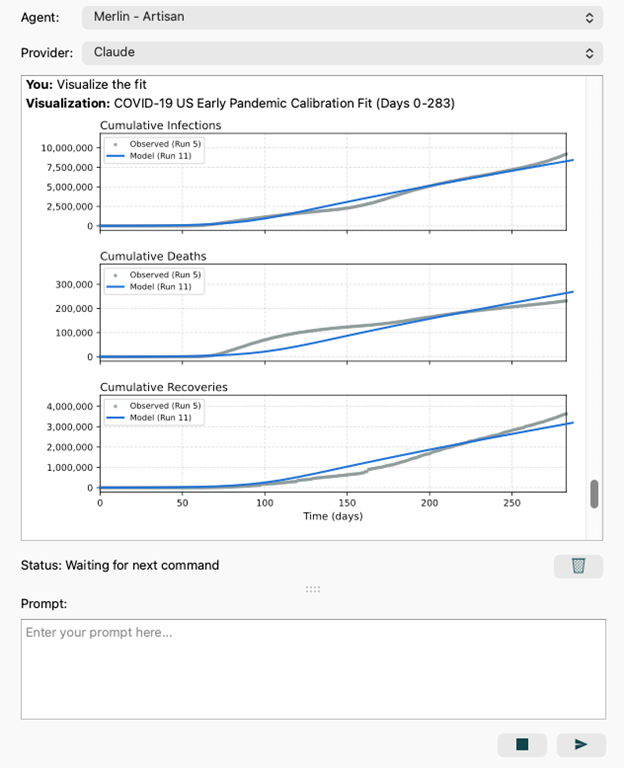 Agent-guided calibration connects models to observed data
Debugging and Structural Awareness
Even for experts, model behavior can be surprising. Oscillations emerge where stability was expected; delays amplify dynamics in unanticipated ways. Diagnosing these patterns typically requires careful inspection of feedback loops and accumulations.
Merlin supports the process by surfacing candidate explanations for observed behavior. It uses Loops That Matter™ to highlight the loops that matter, point to inconsistencies, and suggest areas where structure may require attention. These are not hidden corrections but explicit analytical aids, presented in a way that the modeler can interrogate and refine.
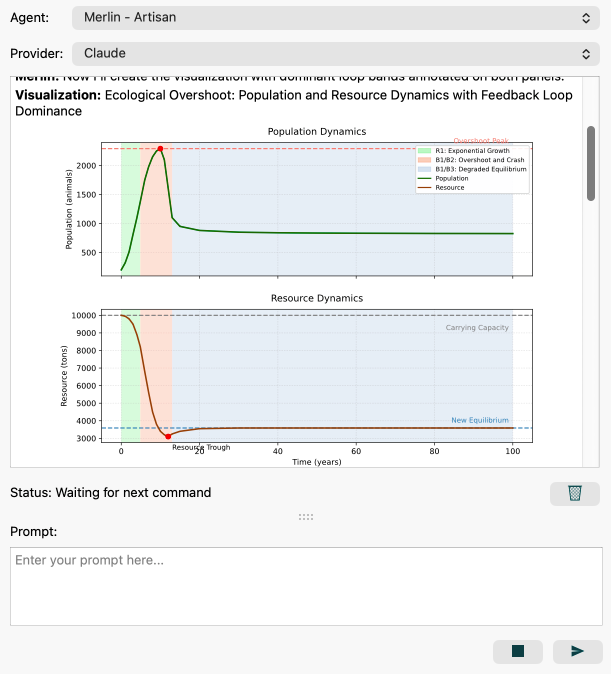 Merlin surfaces candidate feedback structures behind observed dynamics
Building Trust in Your Work
Trust is often a concern when using AI. Here, transparency addresses that directly. Every action taken by Merlin produces visible model-based artifacts: model formulations, simulation outputs, sensitivity analyses, and calibration diagnostics. Nothing is hidden. The modeler retains authority over every assumption, boundary, and interpretation. Merlin simply reduces the friction required to move between these steps, allowing expertise to be applied more continuously and effectively. The discipline of System Dynamics, its emphasis on structure, feedback, and behavior over time, remains intact. All output from Merlin is based on the model, and all input to Merlin is reflected in that model.
The Role of the Expert Modeler
Despite this acceleration, the role of the human modeler remains fundamentally the same. Experienced practitioners define the questions, establish boundaries, assess assumptions, and interpret results. These responsibilities cannot be delegated because they are inherently judgment driven. Merlin’s efforts create more capacity for those activities by reducing the time spent on execution. Experts can then focus fully on interpretation, synthesis, and decision-making.
Conclusion: Extending Expertise
Merlin raises the ceiling by enabling experienced modelers to operate at greater speed and scale without losing trust and transparency in their work. The agentic transformation in Stella Architect 4.3 represents a paradigm from tools that assist modeling to systems that extend expertise itself. Earlier advances made it easier to build models. Merlin makes it easier to fully exercise mastery, and for experienced System Dynamics practitioners, that is where the next frontier lies.