Socrates: Lowering the Barrier for Newcomers to System Dynamics in Stella® Architect 4.3
This is the first of a two-part series. Make sure to also watch our webinar.
System Dynamics has long offered one of the most powerful lenses for understanding complex systems. Yet for decades, a paradox has persisted: while the insights of the field are broadly valuable, the practice of modeling itself remains accessible to relatively few. This is because building models has historically required training in both the technique and the methodology, combining technical skills, iterative experimentation, and disciplined feedback-based reasoning that have been difficult to acquire without lots of practice.
The release of agentic modeling capabilities in Stella Architect 4.3 represents a step toward resolving that tension, not by simplifying the science, but by embedding the process of modeling itself within the software.
From Tools to Workflows
Early applications of generative AI in System Dynamics focused on individual tasks: generating causal loop diagrams, constructing stock-and-flow models, or explaining simulation results. These systems showed that large language models could function as information transformers, converting structured inputs into structured outputs.
But modeling is not a single step, it is a process. It involves: framing a problem, defining system boundaries, formulating structure, testing behavior, ideating policy, and iterating repeatedly. Historically, that workflow lived entirely in the mind of the modeler.
Agentic modeling changes that.
What Makes Agentic Modeling Different?
In Stella Architect 4.3, AI is no longer limited to one-off interactions. Instead, it operates iteratively through these steps:
- Build a model
- Simulate behavior
- Analyze results
- Identify issues
- Revise structure
This iterative agent loop allows the system to internalize the modeling workflow itself, reducing the need for users to know what to do next at each stage.
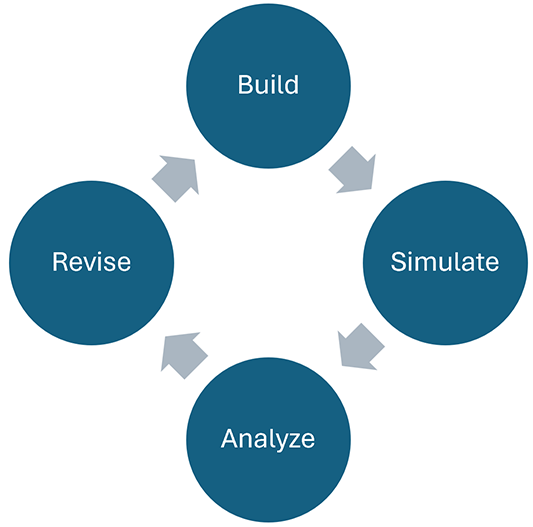
Agentic modeling embeds the iterative SD workflow inside the AI system
Socrates: A Coach for Thinking in Systems
A defining feature of the agentic capability in Stella Architect 4.3 is the introduction of Socrates, an agent designed not to build models immediately, but to help users think.
Rather than jumping straight to model construction, Socrates asks questions.
- What problem are you trying to understand?
- What behavior over time are you concerned with?
- What is inside the system boundary, and what is outside?
- What accumulates? What flows?
- What feedback processes might be at work?
This is not incidental behavior. It is deliberate.
Socrates is designed to teach the System Dynamics method through interaction, guiding users through problem articulation before any equations are written. It enforces a principle long emphasized in the field: good models start with good questions.
Instead of automating modeling, Socrates coaches it.
Why This Matters
For newcomers, one of the greatest barriers is not syntax; it is thinking dynamically. Knowing how to move from a vague problem to a structured model is difficult, even with tools.
Socrates lowers that barrier by asking the right questions at the right time, slowing down premature model construction, encouraging reflection on assumptions and boundaries, and building intuition about feedback and accumulation.
In doing so, it transforms AI from a generator into a learning aid for the discipline itself.
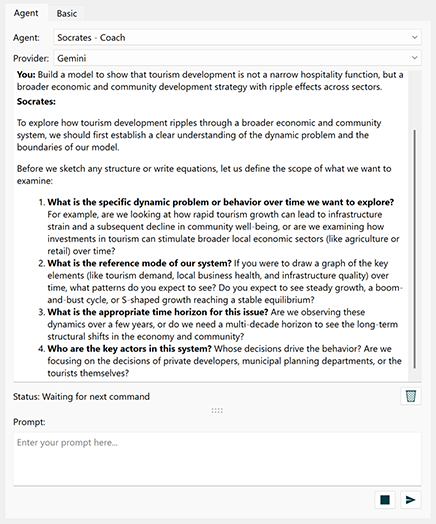
Socrates helps users think before they model
Lowering the Barrier, Twice!
Agentic modeling as embedded in Stella Architect 4.3 reduces barriers in two distinct ways. First, the effort required to implement models is reduced through automatic model generation, built-in simulation and visualization, and integrated calibration and sensitivity analysis. More importantly, agentic systems reduce the need to know when to validate a model, how to interpret model behavior, and what step to perform next. This procedural knowledge, the craft of modeling, is partially embedded in the agent itself. This represents a second-order shift: the system is not just helping users build models, it is helping them practice the methodology.
Still Transparent, Still Rigorous
A natural concern is whether automation comes at the expense of rigor. In this architecture, the answer is no.
Every action taken by the agent produces explicit artifacts including: simulation models, time-series outputs, feedback loop analyses, and calibration and optimization results. Users can inspect, challenge, and modify every step. The system does not replace modeling judgment; it externalizes and accelerates the workflow while keeping it visible. This aligns with the broader push in the community to ensure that AI-supported modeling remains interpretable and verifiable through simulation structures.
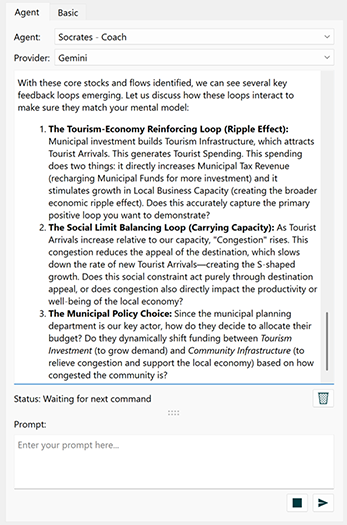
Socrates verifies its understanding before building the model
From Assistant to Partner
With the Stella integration, the agent participates in the full modeling life cycle:
- Scoping and model design
- Model construction from natural language
- Simulation and debugging
- Feedback-based explanation (Loops that Matter™)
- Calibration to data using optimization
- Uncertainty exploration with large ensembles
- Policy optimization and analysis
This makes the agent more than an assistant. It becomes a modeling partner, capable of contributing across conceptual, analytical, and empirical tasks.
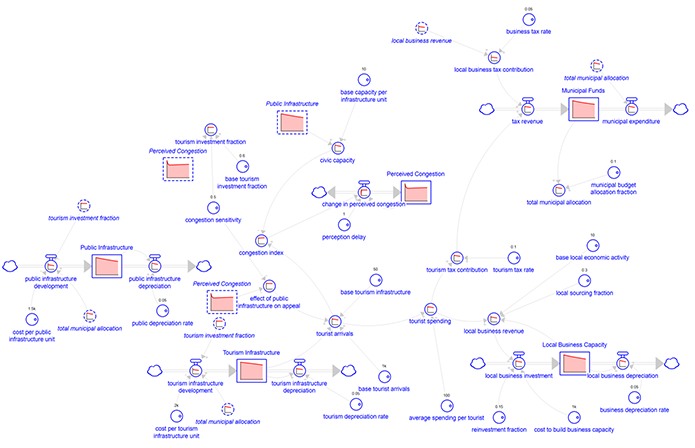 The model built by Socrates
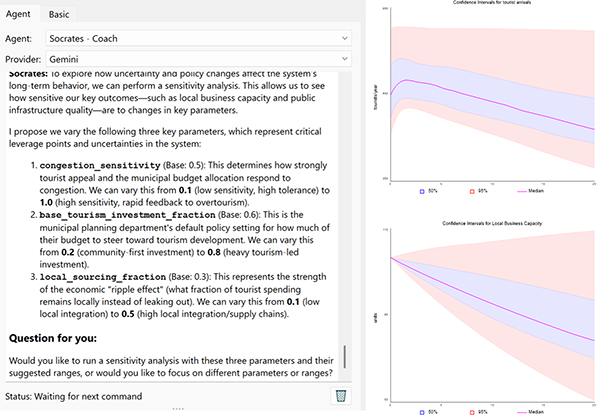 Agentic workflows enable uncertainty analysis
Expanding the Field
The broader implication for System Dynamics is significant.
By lowering both technical and procedural barriers, agentic modeling opens participation to new users. It shortens the time from question to insight, while supporting learning through guided interaction. This reinforces methodological discipline through embedded practices, At the same time, it preserves what makes System Dynamics distinct: the explicit connection between structure, behavior, and feedback.
The Role of the Human Modeler
Despite these advances, one thing remains unchanged. The human modeler is still responsible for controlling the process, everything from framing the problem, setting boundaries, evaluating assumptions and interpreting results. Agents like Socrates do not replace these roles, they make them more accessible.
Conclusion: Lowering Barriers Without Lowering Standards
Agentic modeling in Stella Architect 4.3 represents a shift from tools that assist with modeling to systems that participate in the modeling process. Socrates helps newcomers develop understanding. This points toward a future where more people can engage with dynamic systems, more models are built, tested, and iterated, and more insight emerges from structured, transparent reasoning. Earlier advances reduced the cost of writing models; agentic systems reduce the cost of knowing how to model. And that is the most important barrier to lower!